
Claude for Climate | Episode 7 of 7
Six episodes have been about the work. This one is about the people who decide whether the work gets funded, and why the window for getting it right is measured in reporting cycles, not decades.
The window is a calendar, not a slogan
When people say the window is closing, they usually mean the climate. That is true. But for an executive team there is a more immediate window, and it is printed in the reporting calendar.
In Australia, mandatory climate reporting began for the largest companies in January 2025. Group 2 entities started their first reporting period on 1 July 2026, Group 3 follows from 1 July 2027, and the legislation requires reasonable assurance of all climate disclosures for years commencing 1 July 2030. Scope 3 becomes mandatory from an entity’s second reporting period.
The same pattern is playing out elsewhere. In California, CARB set 10 November 2026 as the first deadline for Scope 1 and 2 reports from companies with more than $1 billion in revenue, with Scope 3 expected from 2027. The EU pushed CSRD back two years for large companies, which is a delay, not a cancellation. And 35 jurisdictions had adopted the ISSB standards by July 2026, with 11 more planning to.
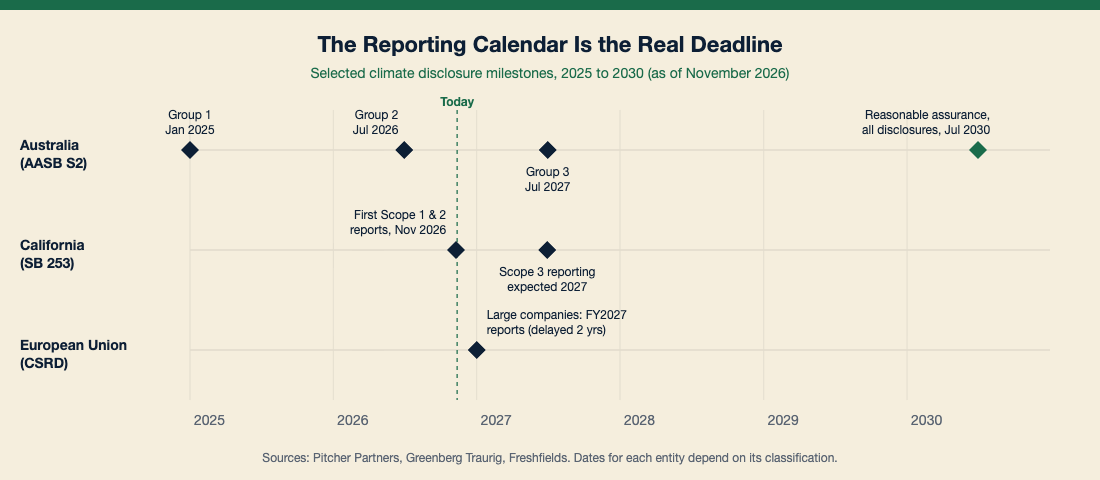
Not every company faces every regime. The point is that assurance changes the nature of the work. Limited assurance asks whether anything looks wrong. Reasonable assurance asks you to show that it is right. The data infrastructure that survives the first will not survive the second, and in my experience it takes more than one reporting cycle to build. A leadership team that starts in 2029 is starting too late.
Why this is a leadership problem, not a tooling problem
Look back at the limitations section of every episode in this series. Incentives that do not reward supplier performance. Data that nobody will stand behind. Regulatory rules that keep moving. Systems in the basement that were never designed to talk to the reporting layer. None of those is solved by software. They are solved by who owns the function, how it is funded, and what gets rewarded.
I learned this the slow way. At Cisco with EnergyWise, and later building the Sustainable Buildings business at AWS, the technology was rarely the constraint. The constraint was whether facilities, finance and IT could agree on who owned the data, who paid for the meters, and who got credit for the savings. Where those questions had answers, programs scaled. Where they did not, the best platform in the world sat underused.
AI raises the stakes in both directions. It can compress the human effort between data and decision, which is the argument of Episode 6. It is also a growing source of the emissions leaders will have to report. The IEA estimates data centres used 415 TWh of electricity in 2024 and projects 945 TWh by 2030. The same executives approving AI budgets are approving a line in next year’s Scope 2 inventory. Both decisions belong in the same conversation.
Four investment decisions that matter more than the tool choice
If I were advising a board deciding where to put money in the next 18 months, these are the four calls I would push them to make explicitly.
Own the data, not just the report
Name one executive accountable for emissions data quality, with the same standing as the owner of financial data. A report has an author. A dataset needs an owner.
Fund foundations before dashboards
Metering, supplier data agreements and open access to building systems, as covered in Episode 5. A dashboard on weak data is a faster way to be wrong.
Put AI where the human effort is
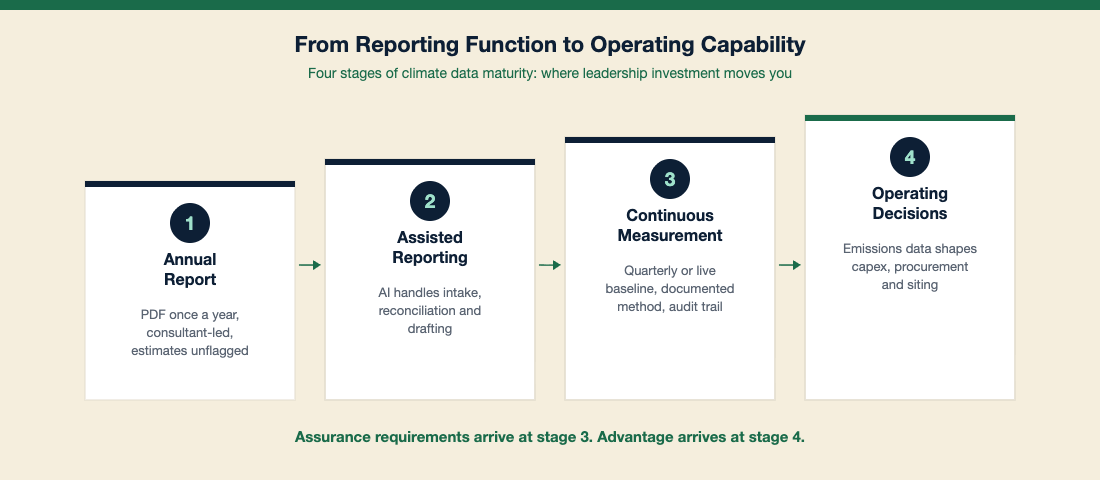
Intake, reconciliation, disclosure reading and documentation. That is where the weeks go, and where Claude gives a small team leverage it has never had.
Govern the AI like any other control
Documented prompts, reviewed outputs and an audit trail an assurer can follow. If you cannot explain how a number was produced, you cannot sign it.
Taking the politics out of it
In some markets, sustainability has become a culture war. People disagree in good faith about the pace and stringency of regulation, and that debate is legitimate. But it has made a lot of executives quieter about climate work than the underlying economics justify.
Data is the way through. An emissions figure measured to an auditable standard is a cost line, a risk exposure and an efficiency opportunity, regardless of how anyone votes. The energy programs I watched succeed were rarely sold on values alone. They were sold on kilowatt-hours, dollars and uptime, and the carbon reduction followed. A leadership team that treats climate as a measurement discipline does not need to win the political argument to make progress. It needs the numbers to be right.
That is the most useful thing AI does here. It does not settle the debate. It makes the facts cheaper to establish, easier to check, and harder to argue with.
What this does not solve
Claude does not create accountability. It can show you where the gaps are in hours. It cannot make anyone responsible for closing them. That is a decision only leadership can make.
Claude does not stop the rules from moving. CSRD has been delayed, California’s first deadline shifted, and Australia’s thresholds have been under review. Build for the direction of travel, not for the current date.
Claude does not make AI’s own footprint disappear. Using AI to manage emissions while AI demand grows is a real tension. The honest answer is to measure and disclose it, not to wave it away.
Claude does not replace assurance. Faster is not the same as right. The value is in giving people more time to check the work, not less reason to.
Prompt patterns for leaders
The earlier episodes gave prompts for the people doing the work. These four are for the people deciding what work gets done.
Prompt pattern 1: Exposure map
“We are an Australian company with [revenue, gross assets, employees] and operations in [jurisdictions]. Based on current rules, which climate disclosure regimes apply to us, from which reporting period, and at what assurance level? Flag anything that is proposed rather than final, and tell me what would change our classification.”
Prompt pattern 2: Assurance readiness test
“Here is our Scope 1 and 2 calculation workbook and methodology note. Act as a reviewer performing reasonable assurance. List the evidence you would request for each material figure, mark which items we can supply today, and rank the gaps by the effort required to close them.”
Prompt pattern 3: Investment case
“Here are our current sustainability team costs, consultant spend and reporting calendar. Build a one-page investment case comparing three options: the status quo, an AI-assisted workflow on our current data, and AI plus metering and supplier data upgrades. State every assumption and show where the answer is most sensitive to them.”
Prompt pattern 4: AI footprint briefing
“Using our cloud provider’s carbon reports and our AI usage data for the last two quarters, estimate the emissions associated with our AI workloads. Explain the method and its uncertainty, and recommend how we should disclose it to the board and in our climate statement.”
Where the series ends
This series started with a simple claim: you cannot manage what you have not measured, and most organisations are reporting on climate before they have measured it. Seven episodes later, that is still the argument.
- Episode 1: Benchmarking and Boundaries
- Episode 2: The Data Problem Behind Corporate Emissions Reporting
- Episode 3: The Supplier Engagement Problem
- Episode 4: The Two Numbers in Amazon’s Emissions Report
- Episode 5: The Data That Doesn’t Speak IP
- Episode 6: How Claude Changes the Equation
The tools are better than they have ever been. What remains scarce is leadership willing to treat climate performance with the same rigour as financial performance, before a regulator or an assurer makes the decision for them.
That closes Claude for Climate. The next series goes one layer down, to the infrastructure underneath all of this: AI and the data centres that run it.